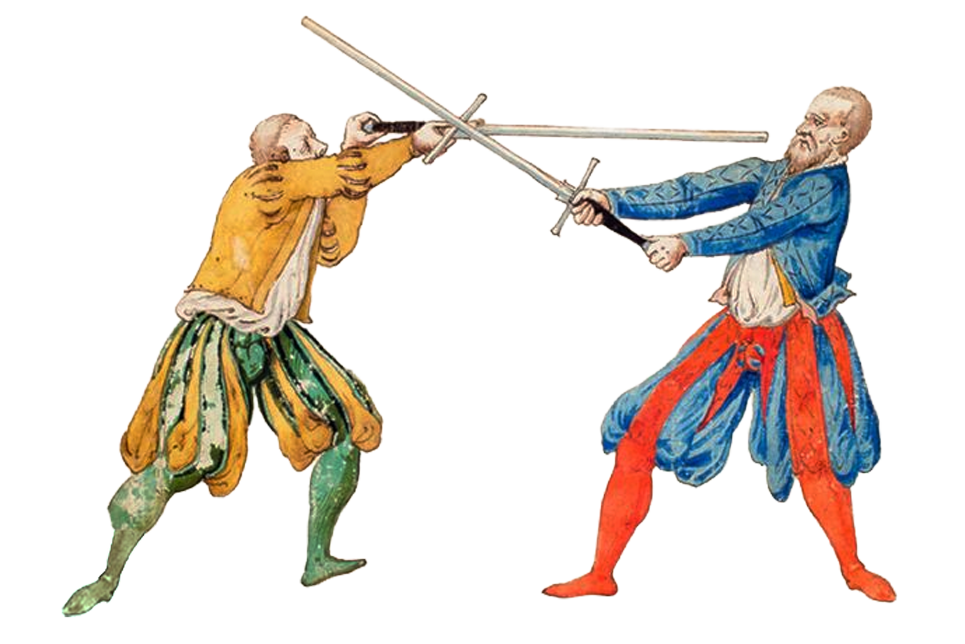
FOUR WAYS TO EXPLORE
Choose a guard you stand in, a cut you intend to throw, a posture your opponent holds against you, or explore plays from the manuals. Each path opens onto a branching sequence drawn from the historical fencing books.
Hut · Posta
Begin from a guard
The chief postures of the long sword. Each guard is a doorway: stand in it and the cuts that follow are already half-formed.

Vom Tag
— from the roof
Sword raised over the shoulder; every descending cut waits in the arms.
Enter the play →
Ochs
— the ox
Hands by the ear, the point levelled at the face like the horn of an ox.
Enter the play →
Pflug
— the plow
Hilt at the hip, point levelled forward. The Plow — Italian Posta Breve.
Enter the play →
Alber
— the fool
Sword hanging low in front, point at the ground. The Fool — Italian Tutta Porta di Ferro.
Enter the play →
Langort
— long point
Arms long, point at their face. The Long Point — Italian Posta Longa.
Enter the play →
Posta di Donna
— guard of the lady
Fiore's Guard of the Lady — Italian counterpart to Vom Tag.
Enter the play →.jpg?width=900)
Posta di Finestra
— window guard
Fiore's Window Guard — Italian counterpart to Ochs.
Enter the play →Hauen · Colpi
Begin from a cut
The hidden strokes of the Liechtenauer verse, as Meyer arranges them. Each cut is an attack and, when read backwards, the answer to another.

Oberhau
— upper stroke
The plain descending cut. Italian fendente. Foundation of every other high stroke.
Enter the play →
Zornhau
— wrath stroke
The wrath cut. A diagonal from the right shoulder, the strongest of the hidden strokes.
Enter the play →
Krumphau
— crooked stroke
The crooked cut. Crossed hands meet the incoming blade across its line.
Enter the play →
Zwerchhau
— crosswise stroke
The crosswise cut. Short edge above the head, the named counter to Vom Tag.
Enter the play →
Scheitelhau
— parting stroke
The Parter. A vertical cut at the parting of the hair — destroyer of Alber.
Enter the play →
Unterhau
— under stroke
The under-stroke. A rising cut from below, the natural exit from Alber.
Enter the play →Gegenfechter
Begin from the opponent's stance
Read their posture first. What they stand in dictates what you may safely do — and what would be a gift.

Schielhau
— squinting stroke
They stand in Vom Tag and will strike from above. Squint along the same line with the short edge.
Enter the play →_107v.jpg?width=900)
Winden
— winding in the bind
Their blade is already on yours in the bind. Stay on their steel and let the leverage decide.
Enter the play →Absetzen
— setting aside
They thrust from Pflug or Ochs. Set the point aside with one of your own along the same line.
Enter the play →
Nachreisen
— travelling-after
They withdraw or miss their cut. Chase the absent blade into the opening left behind.
Enter the play →.jpg?width=900)
Durchwechseln
— changing through
They reach for your blade. Drop the point under and re-present on the far side.
Enter the play →
Sturzhau
— plunge cut
They keep a low or hanging guard. Plunge the point from above before they can rise.
Enter the play →Stücke · Giochi
Step through a scripted play
Sequences preserved as scripts by the masters. Step through each named action in order, with the folio image changing at every move, then deviate into the branches when you wish.
Zornhau-Ort
— the wrath cut and its point
Liechtenauer's Zornhau-Ort — wrath cut, bind, wind, thrust. Four steps.
Enter the play →
Primo Magistro di Zogho Largo
— first master of the wide play
Fiore's First Master of the Wide Play — crossing at the tips, turn, thrust to the face.
Enter the play →
Einlaufen
— running in
Talhoffer's running-in — receive the cut, pass past their foot, seize, throw.
Enter the play →Zornhau mit Winden
— wrath-cut with the winding
Liechtenauer's wind from the wrath bind — strong on strong, hilt high, point falls from above.
Enter the play →Krumphau gegen Ochs
— crooked cut against the ox
Krumphau against Ochs — offline step, crossed hands across the line, press the hands.
Enter the play →Zwerchhau gegen Vom Tag
— thwart-cut against the day guard
Zwerchhau against Vom Tag — short edge across, wind into Ochs, thrust.
Enter the play →Schielhau gegen Langort
— squinting cut against the long point
Schielhau against the Long Point — short edge along their line, nachreisen into the opening.
Enter the play →Scheitelhau gegen Alber
— parter against the fool
Scheitelhau against Alber — high vertical at the parting of the hair, wind if parried.
Enter the play →Vier Versetzen
— the four settings-aside
The Four Settings-Aside — one master cut against each of the four guards.
Enter the play →Nachreisen (script)
— travelling-after as a sequence
Travelling-after — they withdraw, you ride the absent blade into the opening.
Enter the play →Überlauffen
— overrunning
Overrunning — they cut low, you rise above and arrive first from a higher line.
Enter the play →Absetzen (script)
— setting-aside as a sequence
Setting-aside — step offline, deflect with the strong, riposte on the same line.
Enter the play →Durchwechseln (script)
— changing-through as a sequence
Changing-through — their parry meets nothing, your point appears on the far side.
Enter the play →
Zucken
— jerking from the bind
Jerking from the bind — snatch the blade back, restrike the over-committed opening.
Enter the play →
Durchlauffen
— running-through
Running-through — crash inside their guard, drop the sword, throw.
Enter the play →Abschneiden
— slicing-off
Slicing-off — the edge dragged along the arms, upper and lower slice from the bind.
Enter the play →Hende Drucken
— pressing the hands
Pressing the hands — strong on weak, force their hilt down, strike the opening.
Enter the play →Die Hengen
— the hangings
The Hangings — the strong of the blade as a shelf, the wind as the answer.
Enter the play →Die Winden (24)
— the twenty-four windings
The twenty-four windings — bind, feel, wind, resolve as thrust, cut or slice.
Enter the play →Mutieren
— mutating
Mutating — the parried cut becomes a thrust beneath their blade.
Enter the play →Duplieren
— doubling
Doubling — the short edge wraps over the bind for a second blow.
Enter the play →Fühlen & Indes
— feeling and meanwhile
Fühlen & Indes — feel at the bind, soft thrusts, hard winds, neither pauses.
Enter the play →.jpg?width=900)
Secondo Magistro di Zogho Largo
— second master of the wide play
Fiore's Second Master of the Wide Play — crossing at mid-sword, slide the edge over the hands.
Enter the play →Pigliare la Spada
— seizing the sword
Fiore's Sword-Seizure — from the mid-cross, advance and seize their blade.
Enter the play →Volta di Spada
— turn of the sword
Fiore's Turn of the Sword — withdraw the point, rotate around the bind, strike from the new angle.
Enter the play →Primo Magistro di Zogho Stretto
— first master of the close play
Fiore's First Master of the Close Play — cover at half-sword, pommel strike, throw.
Enter the play →Ligadura Mezana
— the middle bind
Fiore's Middle Bind — step in, lock their sword arm, strike the face.
Enter the play →Meza Porta di Ferro
— the half iron gate
Fiore's Half Iron Gate — receive the cut on the inclined blade, rise into the thrust.
Enter the play →Zornhut-Stück
— the wrath-guard device
Meyer's Wrath-Guard device — feint a high cut, drop into a Zwerchhau at the ear.
Enter the play →Ochs-Stück
— the ox device
Meyer's Ox device — thrust, wind from right Ochs to left Ochs, thrust again.
Enter the play →Pflug-Stück
— the plow device
Meyer's Plow device — thrust the chest, if parried low, mutate upward to the throat.
Enter the play →Alber-Stück
— the fool's device
Meyer's Fool device — invite the cut, spring offline, rise into the head.
Enter the play →Das Zucken im Krieg
— the withdrawal at the bind
Meyer's Withdrawal — pass back as you Zuck, pass forward as you restrike.
Enter the play →Übergang zum Halbschwert
— transition to half-sword
Talhoffer's transition to half-sword — the simultaneous Oberhau becomes a half-sword thrust.
Enter the play →Sturzhau (Talhoffer)
— plunge-cut sequence
Talhoffer's plunge — the parried Oberhau is converted into a downward point.
Enter the play →Entgegenstich
— the counter-thrust exchange
Talhoffer's counter-thrust — their thrust from Ochs is parried from Pflug, then answered.
Enter the play →
Ringen am Schwert
— wrestling at the sword
Talhoffer's Wrestling at the Sword — trap the blade, grip the wrist, throw.
Enter the play →